
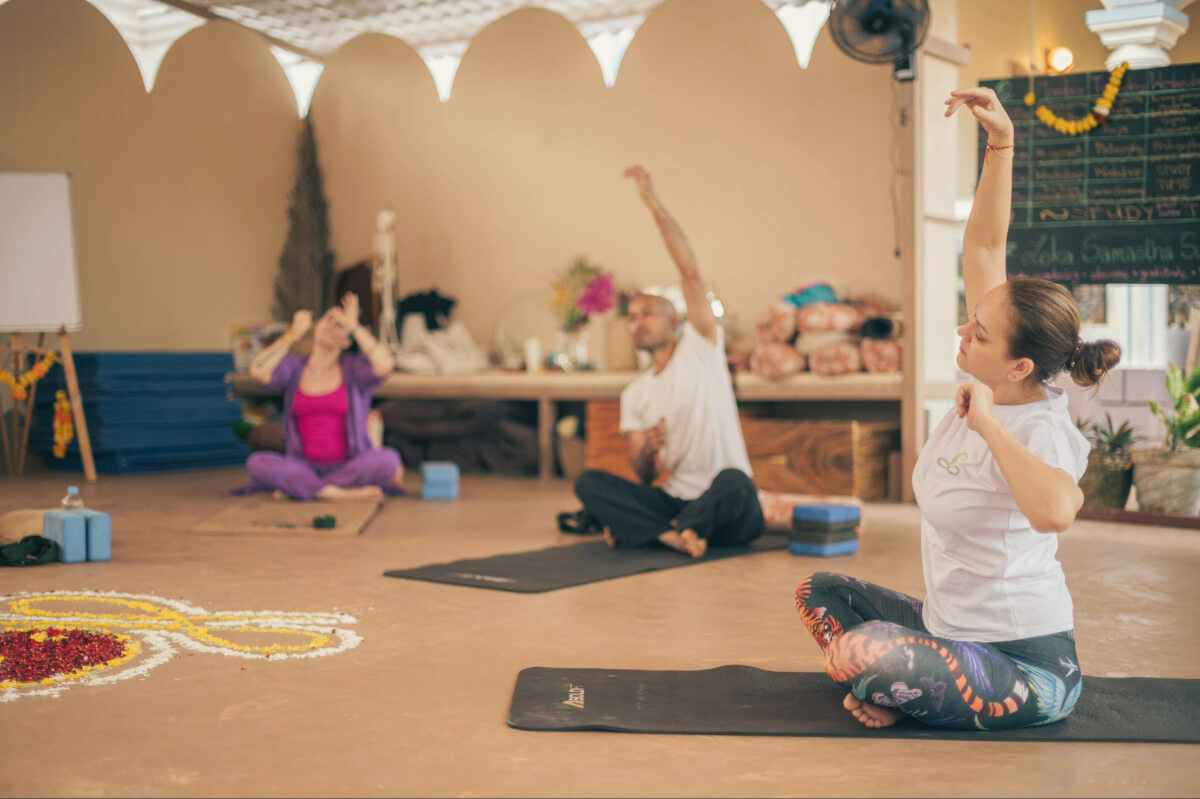
Can yoga help release stored trauma? It is one of the most common questions people bring to yoga teachers. The honest answer: yoga is not a replacement for clinical trauma therapy, but body-based practices can support healing in ways that conversation alone often cannot. This is what trauma-informed somatic yoga is built for.
What is somatic trauma release?
Somatic trauma release refers to body-oriented practices that help people notice and regulate physical patterns linked to stress, anxiety, or difficult past experiences. It includes grounding, breath awareness, slow movement, gentle shaking, and supported rest. No one is required to revisit specific memories.
“Somatic” means relating to the body. In this context, it describes practices that work through sensation, posture, and movement rather than verbal analysis or recollection.
Trauma changes how a person experiences their body. Some people feel tense or guarded. Others feel numb, restless, or disconnected from physical sensation. A more accurate description than “trauma stored in the body” is this: the nervous system can learn protective patterns through repeated stress or danger, and body-based practices may help those patterns soften over time.
Related reading: What Is Somatic Yoga?
Can yoga help release stored trauma?
Clinical guidelines position yoga as a complementary practice, not a standalone treatment for PTSD. India’s Ministry of AYUSH, which governs yoga within India’s national health framework, and the UK’s NICE NG116 both recommend evidence-based psychological therapies such as trauma-focused CBT and EMDR as first-line care.
India has its own research tradition in yoga therapy for trauma. A randomized controlled study by researchers at India’s Patanjali Research Foundation (Telles et al., BMC Psychiatry, 2010) found reduced post-traumatic stress symptoms and improved heart rate variability among Bihar flood survivors following a structured yoga programme.
The framing used by responsible trauma-informed teachers is this: yoga creates conditions for the body to feel safer and more self-directed. Whether that constitutes “release” depends on what each person brings to the practice and what they need from it.
How does somatic yoga help emotional healing?
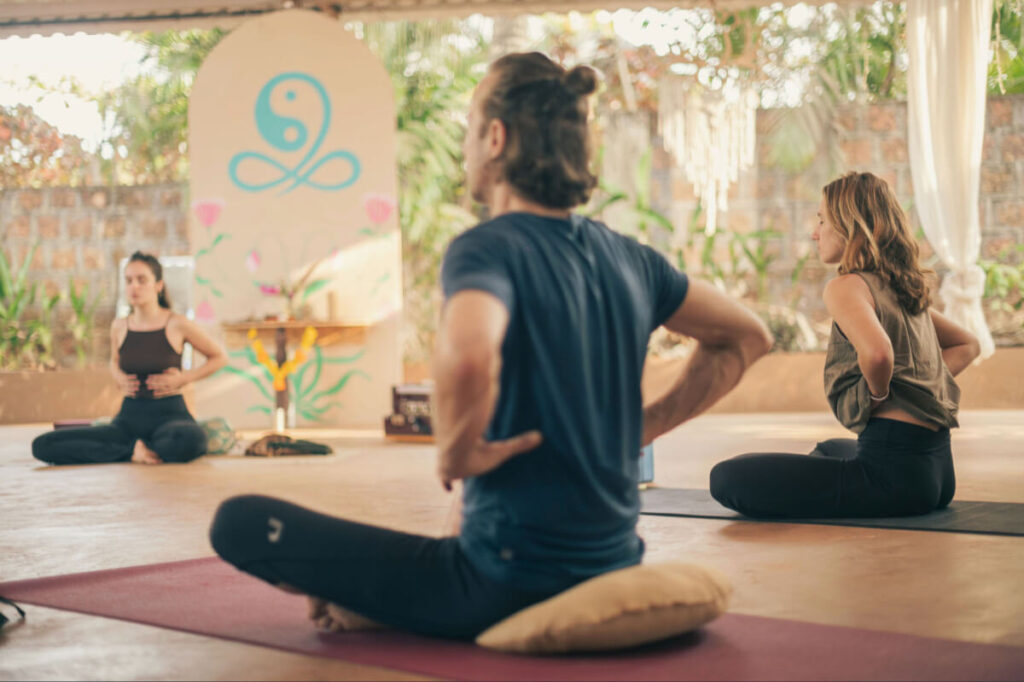
Somatic yoga supports emotional healing by giving the nervous system repeated physical experiences of safety. A trauma-informed class works through slow movement, breath, and grounding rather than flexibility or performance. The mechanism is choice: students are offered options at every stage, and rest is always available.
These principles align with the six trauma-informed care values documented by the Substance Abuse and Mental Health Services Administration (SAMHSA), a United States federal public health agency whose trauma-informed care framework is widely referenced by therapeutic yoga programs internationally. The six values are: safety, trust, collaboration, choice, empowerment, and cultural sensitivity.
Bessel van der Kolk, whose 2014 book “The Body Keeps the Score” drew on decades of clinical work with trauma survivors, argued that body-based practices can reach areas of recovery that talk therapy cannot access alone. Yoga does not ask you to explain what happened. It asks you to notice what is here, now.
Emotional responses such as tears, sighing, warmth, or trembling may arise during practice. They are not the goal. In a trauma-informed setting, they are met with steadiness and privacy.
What does a trauma-informed somatic yoga class look like?
A trauma-informed class centres consent, pacing, and choice above instruction. The teacher offers options at each stage, from how you enter a posture to where your eyes rest. Students are never told to push through discomfort, and rest is always available.
Elements a class may include: orienting (slowly looking around the room to register where you are), grounding through feet or hands, slow breath with an extended exhale, gentle joint movement, choice-based postures, and time to notice what changes after movement. Journaling or verbal reflection may be offered, but sharing is never required.
The table below summarises how trauma-informed somatic yoga addresses common trauma responses in the body.
| Physical signs | What a trauma-informed class can offer | |
|---|---|---|
| Hyperarousal (fight/flight) | Tension, jaw clenching, shallow breath, anxiety | Grounding, extended exhale, slow pace, orienting |
| Hypoarousal (freeze/shutdown) | Heaviness, numbness, fatigue, disconnection | Gentle rhythmic movement, warmth, floor contact |
| Dissociation | Feeling ‘far away’, difficulty sensing the body | Five-sense orienting, slow joint circles, physical support |
| Chronic tension | Held breath, tight shoulders, hips, or jaw | Choice-based stretching, restorative rest, gentle shaking |
What are somatic release exercises, and how do they work?
Somatic release exercises are body-based practices that help discharge tension and support nervous system regulation. In a trauma-informed context, they work by giving the body safe, self-directed experiences of movement, breath, and stillness. The aim is not to force a release but to make space for one.
The following exercises are educational in nature. Stop if you feel dizzy, flooded with emotion, numb, or disconnected from your body.
1. Five-sense grounding. Look around the room and name a few things you can see. Notice sounds, points of contact, temperature, and one sensation that feels neutral or pleasant. This brings attention into the present environment.
2. Seated rocking. Sit on the floor or a chair and gently rock forward and back. Keep the movement small. Notice whether your body wants to slow down, pause, or stop.
3. Extended exhale breathing. Without forcing the breath, let the exhale become a little longer than the inhale. If focusing on the breath increases anxiety, keep your eyes open and shift attention to the feeling of your feet instead.
4. Constructive rest. Lie on your back with knees bent, or on your side if that feels safer. Let the floor hold you. You do not need to relax completely; simply notice the support beneath you.
5. Somatic shaking. Stand with feet hip-width apart and knees slightly soft. Gently let the legs bounce, allowing the movement to travel up through the hips, arms, and hands. This follows the same principle as Tension and Trauma Releasing Exercises (TRE), developed by David Berceli. Keep the range small.
6. Slow joint circles. Sitting comfortably, draw slow circles with the ankles, then the wrists, then the shoulders. Keep the pace unhurried. Notice where movement feels free and where it feels restricted, without trying to change either.
Sohum Yoga School in Arambol, Goa includes trauma-informed teaching as a dedicated module in its 200-hour teacher training. India’s Ministry of AYUSH, which oversees yoga within India’s national health framework, recognises yoga as a therapeutic discipline with protocols for stress, anxiety, and mental well-being, reflecting India’s long tradition of body-based healing.
Is TRE the same as somatic yoga?
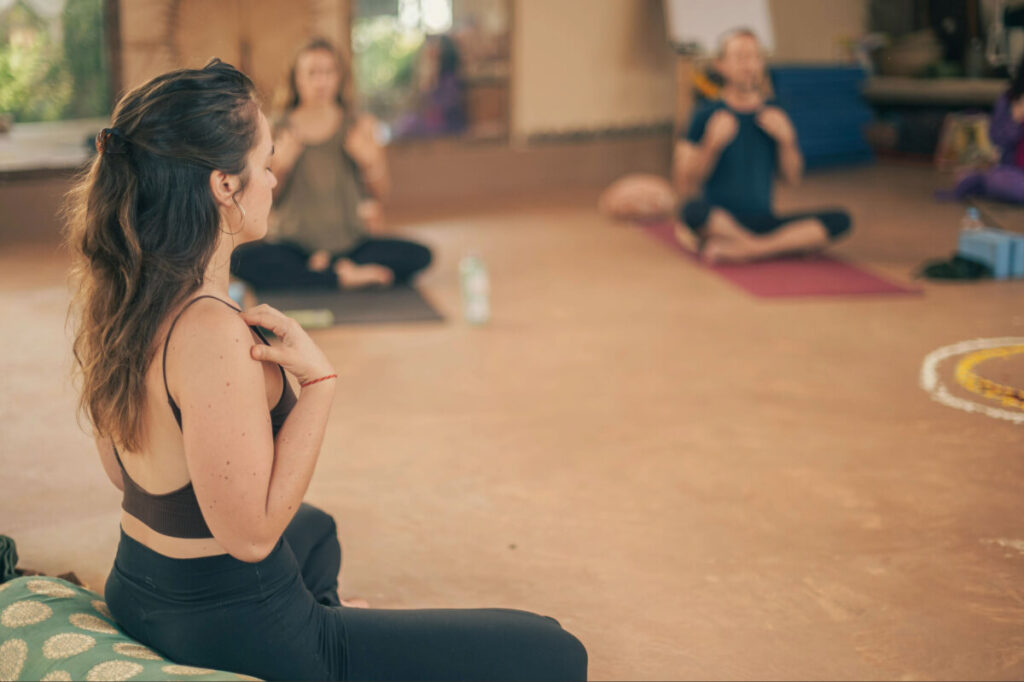
TRE, Tension and Trauma Releasing Exercises, is not a form of yoga. Developed by somatic therapist David Berceli, it uses exercises that induce neurogenic trembling to release deep muscular tension. Some yoga teachers incorporate shaking into their classes, but TRE is a distinct method with its own facilitation protocol.
A pilot study by Berceli, Salmon, Bonifas, and Ndefo (Global Advances in Health and Medicine, 2014) described TRE as a mind-body therapy designed to release deep muscle tension and reduce stress, with findings based on quality of life outcomes among non-professional caregivers. Peer-reviewed research specifically on TRE for trauma remains limited, and more rigorous studies are needed.
If you want to explore TRE, particularly if you have PTSD, dissociation, or a chronic health condition, working with a qualified TRE facilitator is advisable.
Related reading: How to Regulate Your Nervous System
What should you look for in a trauma-informed yoga class?
A class described as trauma-informed should use invitational language rather than commands, offer multiple options for each posture, make rest available at any point, allow students to keep eyes open throughout, avoid hands-on adjustments without explicit consent, and never require sharing personal experiences in a group setting.
Signs that a class is not trauma-informed: teachers who physically adjust students without asking, language that pushes students to “go deeper” or “work through” discomfort, required group sharing, and a consistent emphasis on achieving poses correctly.
Peter Levine, who developed Somatic Experiencing, observed that safety is not just a feeling. It is a physiological state the body either registers or does not. A class that feels pressured or performance-oriented cannot produce this state, regardless of how it is labelled.
How long does somatic yoga for trauma take to have an effect?
Some people notice a shift after a single session, often just a feeling of being more present or less tense. Lasting changes to nervous system patterns generally develop over weeks and months of consistent practice. There is no fixed timeline, and progress is rarely linear.
Brief sessions practised often tend to be more effective than occasional long ones. This is especially relevant for trauma recovery, where the nervous system learns through repetition and safety, not through intensity or willpower.
Frequently asked questions
What is the difference between somatic therapy and somatic yoga?
Somatic therapy is a clinical practice delivered by a trained therapist, often involving verbal processing alongside body-based techniques. Somatic yoga is an educational practice delivered in a class or group setting. It supports self-awareness and nervous system regulation but is not a substitute for clinical care.
Can somatic yoga help with anxiety?
Yes. A 2018 systematic review and meta-analysis by Cramer et al. (Depression and Anxiety, Wiley) of randomized controlled trials found that yoga significantly reduced anxiety symptoms across multiple studies. Slow breathing, grounding, and gentle movement can reduce physiological markers of anxiety and support a sense of calm. Somatic yoga is not a clinical treatment for anxiety disorders, but many people find it a useful part of a broader approach to managing stress.
Is somatic yoga safe for everyone?
Somatic yoga is generally safe, but people with PTSD, dissociation, panic disorder, or a history of serious trauma should approach body-based practices gradually, ideally with guidance from a trauma-informed teacher and in consultation with their healthcare provider. A good teacher will offer options and never push you beyond what feels manageable.
Do I need a diagnosis to benefit from trauma-informed yoga?
No. Trauma-informed yoga is useful for anyone who has experienced stress, difficulty, or a sense of disconnection from their body, whether or not those experiences meet clinical criteria. The practice meets each person where they are, without requiring a history or a label.
What does yoga emotional release feel like?
It varies. Some people cry. Others feel warmth, trembling, or a spontaneous deep breath. Others notice a quiet easing of tension they had not realised they were holding. Emotional release in yoga does not have to be dramatic or visible. It also does not always happen, and the absence of it is not a sign that the practice is not working.