
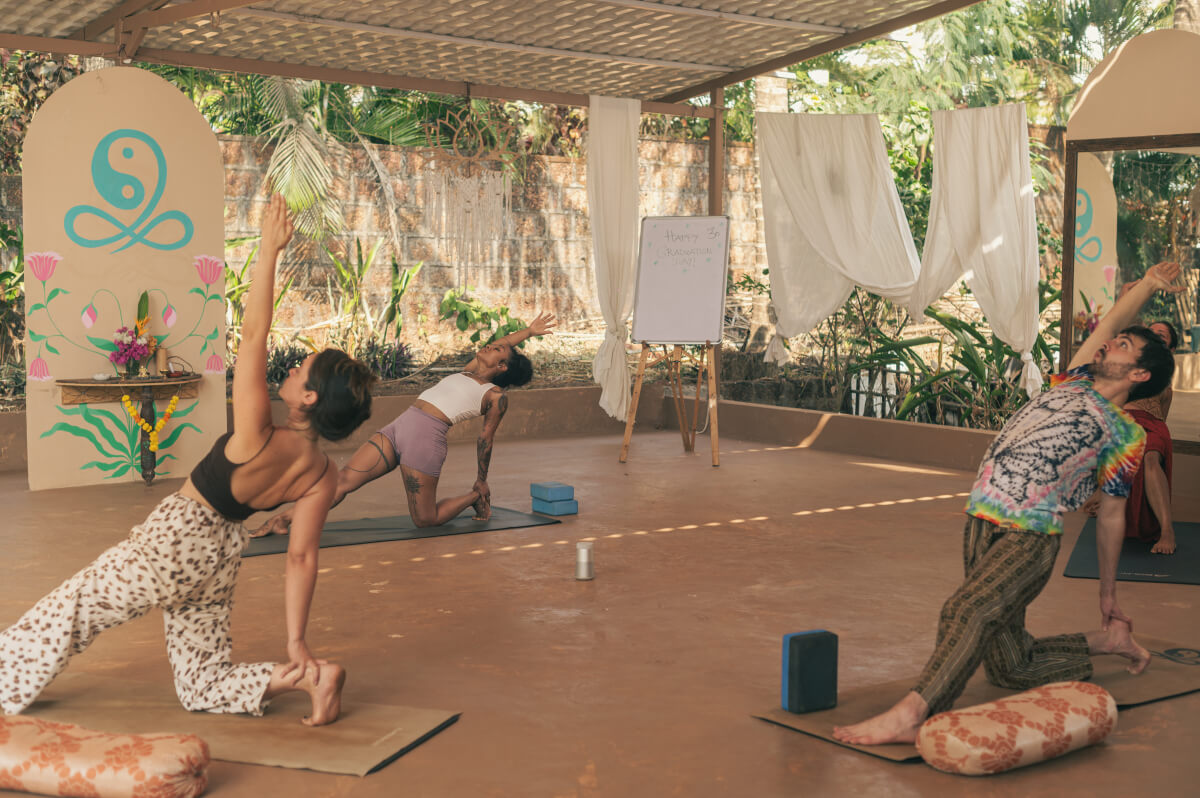
There is a quiet frustration that some yoga practitioners know well. You have been practising for years. The poses look better. But something still feels performed, like you are executing shapes rather than inhabiting them.
Somatic yoga is, in many ways, the answer to that feeling. It does not ask you to learn more poses. It asks you to pay closer attention to the ones you already know.
This guide covers what somatic yoga is, how it works, what the research says, and how it compares to traditional Hatha yoga. If you are curious about embodied movement or considering teacher training that includes somatic practice, this is where to start.
What is somatic yoga?
Somatic yoga is a slow, body-led movement practice that develops awareness from within. Rather than performing a posture’s external shape, it asks you to notice sensation, breath, and ease as you move. It draws from yoga, somatic movement education, and nervous-system-aware teaching.
The word “somatic” comes from the Greek word “soma”, meaning “body”. In movement education, the term refers to the body as experienced from the first-person perspective, a concept Thomas Hanna (philosophy professor and movement theorist) defined when he coined the term in the 1970s. In yoga, this means the emphasis shifts from what a pose looks like to what it actually feels like from inside.
Somatic yoga is not an ancient lineage. It is a contemporary blend that combines classical yoga with insights from somatic movement education. Because the field is broad, it helps to study with teachers who have formal training in both traditions.
What does “somatic” mean in yoga?
In yoga, somatic means practising through internal body awareness rather than external imitation. Instead of copying a shape shown by the teacher, you sense your way through movement by noticing sensation, effort, breath, and subtle shifts in ease. The intelligence comes from within.
Most physical training, yoga included, is taught from the outside in: a teacher observes, corrects, and adjusts. Somatic practice inverts that dynamic. It asks the practitioner to become their own observer and to use what they notice to guide how they move.
In a somatic yoga class, familiar yoga shapes may appear, but the emphasis is on internal inquiry rather than achieving a particular form. This is what some teachers call deep internal listening, and it changes the nature of practice considerably.
How does somatic yoga work?
A somatic yoga session typically begins lying down or seated with props. The teacher guides attention to sensation rather than adjusting posture. Movements are small, repeated, and exploratory. You pause between them to notice what changes. The pace is slow enough for the nervous system to register each shift.
The method tends to include the following elements:
- Small, repeated movements rather than long static holds
- Sensory inquiry: noticing warmth, pressure, effort, or ease
- Gentle breath awareness without forcing the breath
- Individual’s choice about when to pause, modify, or skip movements
- Integration pauses so the nervous system can register change
This is why somatic yoga exercises can feel deceptively simple. A slow pelvic tilt or careful cat-cow becomes a detailed exploration of how the spine, breath, and attention relate. The complexity is entirely internal.
What are the benefits of somatic yoga?
Somatic yoga may improve body awareness, support gentle mobility, and help regulate the nervous system. Its benefits are supportive rather than curative.
Commonly reported benefits include:
- Greater body awareness: learning to notice signals like bracing, shallow breathing, or uneven weight distribution
- Gentle mobility: slow, small movements that support range of motion without aggressive stretching
- Nervous system support: yoga research broadly shows promise for stress-related wellbeing and some anxiety symptoms
- Movement confidence: accessible to people who feel intimidated by stronger or faster yoga styles
- More attentive Hatha practice: somatic awareness tends to make traditional asana more considered and less mechanical
One point worth keeping in mind: gentle somatic sessions are not equivalent to aerobic exercise or strength training. They work well as part of a broader movement life, and that is exactly what they are designed to be.
How does somatic yoga differ from traditional Hatha yoga?
Hatha yoga teaches postures from the outside in, using alignment cues and structured forms. Somatic yoga teaches from the inside out, using small movements and internal inquiry. Hatha trains form, strength, and breath discipline. Somatic yoga trains awareness, self-regulation, and the quality of attention inside any given form.
| Hatha yoga | Somatic yoga | |
|---|---|---|
| Origin | Classical Indian tradition (medieval) | Contemporary movement education (20th century) |
| Primary focus | External form and alignment | Internal sensation and awareness |
| Movement approach | Held postures with teacher cues | Small, exploratory movements with self-inquiry |
| Pace | Moderate to slow | Slow |
| Goal | Strength, flexibility, breath discipline | Body awareness, self-regulation, ease of movement |
| Beginner-friendly | Yes, with modification | Yes, especially for those seeking a slower approach |
| In teacher training | Core tradition and framework | Complementary or integrated awareness module |
Neither approach is superior. They serve different needs and work well together. Hatha yoga provides the structural tradition and the physical forms. Somatic yoga provides the quality of attention that makes those forms more intelligent and sustainable.
At Sohum Yoga School in Arambol, Goa, classical Hatha and somatic embodiment are taught as one integrated approach within the 200-hour teacher training, rather than as separate systems. This reflects the school’s view that understanding the body from within is inseparable from teaching it well.
What somatic yoga poses and exercises can beginners try?
Beginners can start with six foundational exercises: constructive rest, pelvic clock, slow cat-cow, shoulder melt, supine twist exploration, and supported child’s pose. Each takes around 3 to 5 minutes. Move at half your usual range and pause between each one to notice what changes.
1. Constructive rest with breath awareness
Lie on your back with knees bent and feet flat on the floor. Let your hands rest on your belly or ribs. Notice where your body contacts the ground without trying to adjust or fix anything.
Without changing the breath, observe the inhale and exhale for two to three minutes.
Somatic focus: can you feel the body being breathed rather than you forcing the breath?
2. Pelvic clock
Staying on your back with knees bent, imagine a clock face on the back of your pelvis. Gently rock toward 12 o’clock and 6 o’clock, then explore small circles. Keep the movement small and smooth.
Somatic focus: notice whether the lower back, belly, hips, or breath respond.
3. Slow cat-cow
Come to hands and knees, or practise seated if wrists are sensitive. Round and arch the spine slowly, aiming for movement vertebra by vertebra rather than one large shape.
Somatic focus: where does movement feel easy? Where does it feel unclear or absent?
4. Shoulder melt
Lying on your back or seated comfortably, lift the shoulders gently toward the ears, pause, then release slowly. Repeat several times with progressively less effort.
Somatic focus: sense the difference between contracting, holding, and letting go.
5. Supine twist exploration
Lie on your back with knees bent. Let both knees drift a small distance to one side and return to centre. Keep the range minimal. Turn the head only if it feels natural and unforced.
Somatic focus: notice how the ribs, spine, pelvis, and breath all participate.
6. Supported child’s pose or resting shape
Use cushions, a bolster, or folded blankets. Rest forward only if it is comfortable for your knees, hips, and breath. Otherwise, lie on your side or back.
Somatic focus: receive the support rather than stretching into it.
Is somatic yoga good for beginners?
Yes. Somatic yoga is slow, adaptable, and non-competitive. No prior yoga experience is needed, and no flexibility or strength is required. Because it does not ask you to match an external form, beginners often find it more accessible than dynamic yoga styles. A qualified teacher still matters.
Beginners sometimes find somatic yoga easier to engage with than faster practices because there is no performance dimension. The practice meets you exactly where you are.
Choosing a qualified teacher is important, especially if you are working with injuries, chronic conditions, pregnancy, or a trauma history. The National Center for Complementary and Integrative Health notes that yoga is generally safe for healthy people under qualified guidance, with modifications important for those with relevant health conditions.
Are there any safety considerations for somatic yoga?
Somatic yoga is gentle, but gentle does not mean risk-free. Take extra care if you have recent surgery, unexplained pain or numbness, severe osteoporosis, balance challenges, severe high blood pressure, glaucoma, or pregnancy. If unsure, speak with your doctor before starting and tell your teacher about any relevant health conditions.
Somatic yoga therapy can be a useful complementary approach when taught within a proper scope. It does not replace medical care, physiotherapy, or psychotherapy when those are actually needed.
If a teacher or program promises to cure pain or release specific trauma from specific body parts, treat that as a warning sign. Somatic yoga can support awareness and ease. It is not a clinical intervention.
How do you start a somatic yoga practice?
Start with one or two exercises and repeat them three to four times per week. Keep sessions between 10 and 20 minutes. Move at 30 to 50 percent of your maximum range. Choose teachers who offer options rather than corrections, and let comfort, breath, and clarity guide the pace.
A few practical starting points:
- Practise on a comfortable mat, rug, or folded blanket
- Pause after each movement and notice what changed before moving on
- Avoid labelling one side of the body as better than the other
- Keep sessions short enough that curiosity stays alive
If you want to explore how somatic yoga connects with breathwork and nervous system regulation, our upcoming guide to nervous system regulation looks at these connections in more depth.
Related reading: Somatic Yoga for Trauma Release
Frequently asked questions
What is the difference between somatic yoga and somatic therapy?
Somatic therapy is a clinical practice delivered by licensed therapists to treat trauma, anxiety, and nervous system dysregulation. Somatic yoga is a movement and awareness practice. They can work alongside each other, but they have different purposes, different training requirements, and different settings. One does not substitute for the other.
How often should you practise somatic yoga?
Three to four short sessions per week is a reasonable starting point. Aim for 10 to 20 minutes each. More frequent, shorter practice works better than occasional long sessions because the nervous system benefits from regular exposure, not from occasional intensity.
What are the main somatic yoga benefits?
Commonly reported benefits include better body awareness, gentler mobility, nervous system support, greater movement confidence, and a more attentive relationship with traditional yoga postures. Evidence is still developing, so benefits are better described as supportive rather than guaranteed.
Can somatic yoga therapy help with pain or trauma?
Somatic yoga therapy may support body awareness, relaxation, and self-regulation as a complementary practice. It should not replace diagnosis, medical care, physiotherapy, or psychotherapy.